(3^(0))(3^(-2))(3^(2))=\left(3^{0}\right)\left(3^{-2}\right)\left(3^{2}\right)=
A. 3
B. 1
C. 9
D. 0
y^(8)-:y^(2)=quad(y!=0)y^{8} \div y^{2}=\quad(y \neq 0)
A. y^(6)y^{6}
B. y^(4)y^{4}
C. y^(10)y^{10}
D. (1)/(y^(6))\frac{1}{y^{6}}
(3q^(2))^(3)=\left(3 q^{2}\right)^{3}=
A. 3q^(6)3 q^{6}
B. 3q^(5)3 q^{5}
C. 9q^(6)9 q^{6}
D. 27q^(6)27 q^{6}
(P^(3)N^(-2))/(N^(2)P^(4))=\frac{\mathrm{P}^{3} \mathrm{~N}^{-2}}{\mathrm{~N}^{2} \mathrm{P}^{4}}=
A. P^(-1)\mathrm{P}^{-1}
B. (P)/(N^(4))\frac{\mathrm{P}}{\mathrm{N}^{4}}
C. (1)/(N^(4)P)\frac{1}{N^{4} P}
D. N^(4)P^(-1)\mathrm{N}^{4} \mathrm{P}^{-1}
If 3^(Y-1)=813^{Y-1}=81, what is the value of YY ?
A. 5
B. 4
C. 3
D. 2
If XX is an integer, which of the following could not equal X^(5)X^{5} ?
A. 0
B. -1
C. 16
D. 32
The greatest common factor of A^(2)B^(4)+B^(3)AA^{2} B^{4}+B^{3} A is:
A. AB^(3)A B^{3}
B. ABA B
C. A^(2)BA^{2} B
D. A^(3)BA^{3} B
Factoring out the greatest common factor from P^(2)Q+P^(4)Q^(2)\mathrm{P}^{2} \mathrm{Q}+\mathrm{P}^{4} \mathrm{Q}^{2} leaves:
A. QP^(2)Q P^{2}
B. Q+P\mathrm{Q}+\mathrm{P}
C. P+Q^(2)P+Q^{2}
D. 1+P^(2)Q1+\mathrm{P}^{2} \mathrm{Q} 9. (-2+4)^(-2)=(-2+4)^{-2}=
A. -4
B. -1//4-1 / 4
C. 1//41 / 4
D. 4
If 3^(6)=9^(X),X=3^{6}=9^{X}, X=
A. 1
B. 2
C. 3
D. 4
Questions 1-10 on each test cover new concepts that must be mastered before moving on to the next lesson. Questions 11-15 cover concepts learned in previous courses or in previous lessons of Algebra 2. You may use these questions as a review tool.
If X+2Y=5X+2 Y=5 and X=1//2YX=1 / 2 Y, then Y=Y=
A. 2
B. 1//21 / 2
C. 1
D. -2
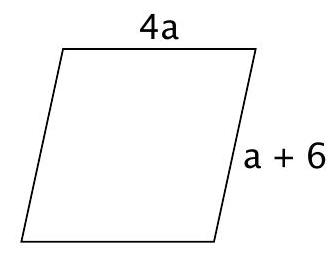
In the rhombus shown, what is the value of aa ?
A. 1
B. 2
C. 3
D. 4
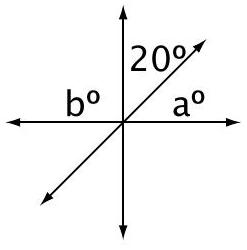
Three intersecting lines are shown. What is the value of b+ab+a ?
A. 170
B. 160
C. 140
D. 70
A recipe requires three eggs and seven cups of flour. If 15 eggs are used, how many cups of flour are needed?
A. 5
B. 19
C. 25
D. 35
What is the slope of a line that passes through the origin and the point (-3,-2)(-3,-2) ?
A. 2//32 / 3
B. -2//3-2 / 3
C. 3//23 / 2
D. -3//2-3 / 2